If you’re asking “how do I know if my cat is pregnant,” you’re not alone — it’s one of the most common questions cat owners search for online. Feline pregnancy can be surprisingly easy to miss in the early weeks, especially if your cat spends time outdoors or you recently adopted an unspayed female. The good news is that cats show a clear progression of physical and behavioral signs as pregnancy advances, and with the right knowledge, you can identify them confidently at home — and know exactly when to call your vet.
This comprehensive guide covers everything: the earliest signs of cat pregnancy, a week-by-week breakdown, how to distinguish pregnancy from other conditions, what your vet will do to confirm it, and how to care for your pregnant cat all the way through delivery.
How Long Is a Cat Pregnant?
A cat’s pregnancy lasts approximately 63 to 67 days, with an average of 65 days — roughly 9 weeks. Gestation can range from 61 to 72 days depending on the individual cat, her age, health, breed, and litter size. Larger litters tend to arrive slightly earlier; smaller litters may go a bit longer.
Key fact: Cats are seasonally polyestrous, meaning they cycle in and out of heat multiple times during breeding season (typically spring through autumn). An unspayed female can become pregnant multiple times per year, which is why cat populations grow so rapidly.
Early Signs of Cat Pregnancy (Weeks 1–3)
The first three weeks of feline pregnancy are the hardest to detect. The embryos are tiny, and your cat’s behavior may barely change. Many cats show no visible signs at all during this stage. That said, some early indicators do appear.
“Pinking Up” of the Nipples
One of the earliest and most reliable signs appears around 2–3 weeks after conception. The nipples — especially in cats that have never been pregnant — become noticeably pinker, more prominent, and slightly swollen. This is known as “pinking up.”
- Nipples shift from pale beige to a rosy pink
- They protrude more than usual
- The area around the nipples feels slightly puffy
- Easiest to spot on short-haired cats
Increased Appetite
As early as 2–3 weeks in, a pregnant cat may begin eating more than usual. The body is fueling the growing embryos. You might notice her finishing meals faster, hovering near her bowl, or asking for food more frequently.
Mild Morning Sickness
Yes, cats can experience a version of morning sickness. Around weeks 3–4, some pregnant cats vomit occasionally or seem momentarily nauseous. This is normal and typically brief. If vomiting is frequent, prolonged, or accompanied by lethargy, consult a vet.
Subtle Weight Gain
Very slight weight gain may occur in the first few weeks, though it’s usually invisible to the eye. If your cat is on a regular weigh-in schedule, you might catch a small uptick of a few ounces.
Physical Signs of Cat Pregnancy (Weeks 3–6)
From around week 3 onward, physical changes become more obvious and easier to detect.
Visible Belly Enlargement
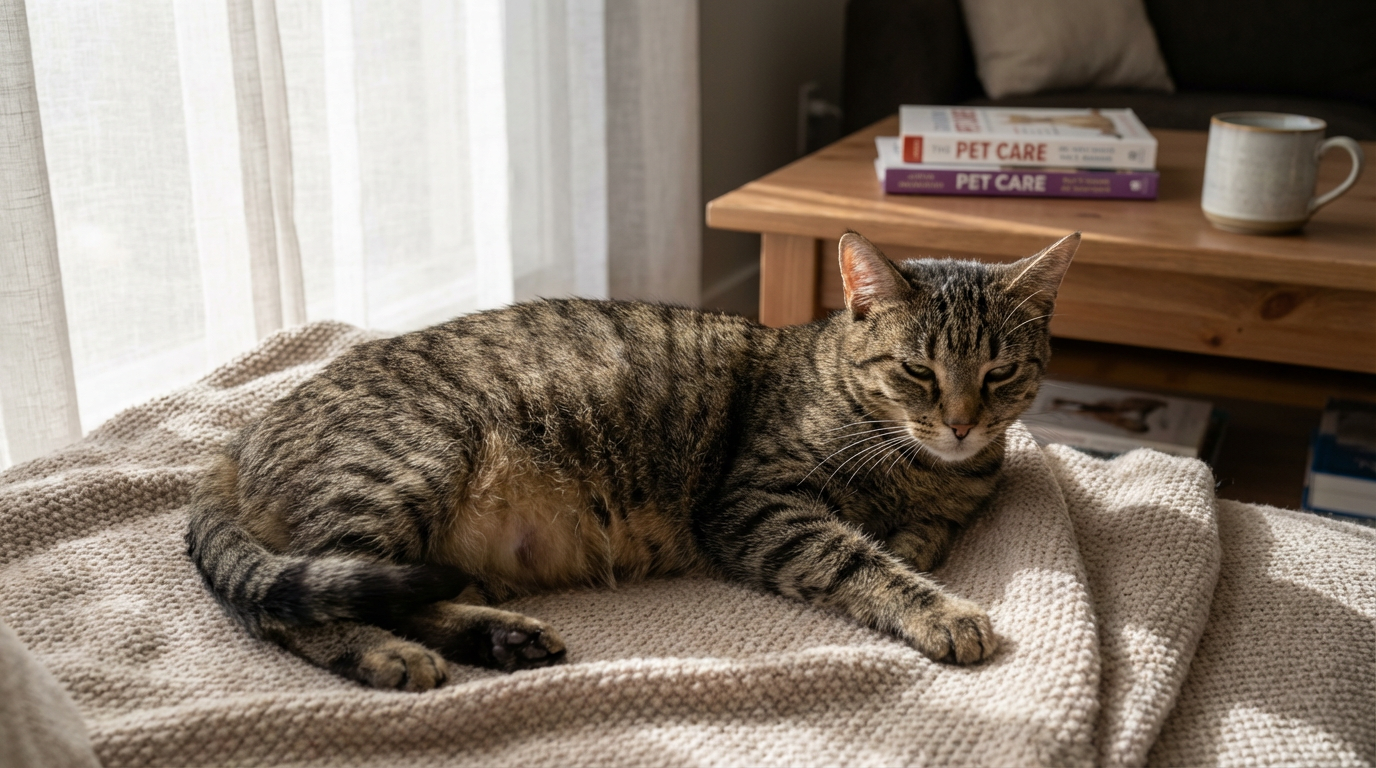
By weeks 4–5, the abdomen begins to visibly round and enlarge. The belly will feel firmer than usual — distinctly distended rather than simply soft with fat. Unlike general weight gain, the enlargement is concentrated in the lower abdomen.
⚠️ Never press hard on a pregnant cat’s belly. The embryos are delicate, and rough handling can cause serious harm.
Weight Gain Becomes Noticeable
A pregnant cat typically gains 1–2 kg (2–4 lbs) over the course of her pregnancy. By week 5, most owners can see the difference without a scale.
Swollen Mammary Glands
By weeks 5–6, all four pairs of nipples begin to enlarge and the mammary glands firm up in preparation for milk production. In the final stages, a milky discharge can sometimes be expressed.
Fetal Movement
In the final 2–3 weeks, if you watch your cat while she’s resting, you may see small ripples or bumps shifting beneath the skin — the kittens moving inside.
Behavioral Signs of Pregnancy in Cats
Pregnancy doesn’t just change a cat’s body — it changes her behavior too.
Increased Affection and Clinginess
Many pregnant cats become noticeably more affectionate. Your cat may follow you from room to room, seek lap time more often, purr more, or vocalize more frequently. This is a hormonal response as she instinctively seeks a safe environment.
Nesting Behavior
One of the most telling signs — particularly in the final 1–2 weeks — is nesting. Your cat will seek out quiet, secluded spots and begin preparing a den.
- Rearranging blankets, towels, or soft bedding
- Disappearing into closets, under beds, or into boxes
- Becoming protective or territorial over a specific location
- Dragging soft items to her chosen spot
Decreased Activity
As the pregnancy advances and her belly grows, your cat will naturally become less active. She may sleep more, climb less, and seem generally more sedentary.
Cessation of Heat Cycles
If your cat has stopped going into heat — no yowling, rolling, or presenting — this alone is a strong signal she may be pregnant, especially if she had recent outdoor access or contact with an intact male.
Week-by-Week Cat Pregnancy Timeline
| Week | Development | Signs You May Notice |
|---|---|---|
| Week 1–2 | Fertilization and implantation | None visible |
| Week 3 | Embryos attach; organs begin forming | Nipples start pinking up; possible mild nausea |
| Week 4 | Kittens ~1.5 cm; heartbeats present | Slight belly rounding; increased appetite |
| Week 5 | Kittens ~5 cm; genders distinguishable | Clear belly enlargement; noticeable weight gain |
| Week 6 | Kittens growing rapidly; fur forming | Swollen mammary glands; reduced activity |
| Week 7 | Kittens nearly fully formed | Visible fetal movement possible |
| Week 8 | Kittens almost ready; gaining weight | Heavy belly; nesting begins in earnest |
| Week 9 | Full term; birth imminent | Active nesting; temperature drop; restlessness |
How to Tell If a Cat Is Pregnant at Home
While only a vet can confirm pregnancy with certainty, this practical checklist will help you assess the situation at home:
- Are the nipples pinker, larger, or more prominent than usual?
- Is she eating noticeably more than normal?
- Is her belly rounder than usual, particularly in the lower abdomen?
- Has she stopped showing heat cycle behaviors (yowling, rolling, presenting)?
- Is she sleeping more and less active than usual?
- Has she started seeking out quiet, private hiding spots?
- Has she become unusually affectionate or clingy?
- Is she an unspayed female with recent outdoor access or contact with intact males?
If you answered yes to three or more of these questions, there is a strong chance your cat is pregnant. Schedule a veterinary appointment for confirmation.
Pregnant Cat vs. Other Conditions: How to Tell the Difference
Not every swollen belly or behavior change means pregnancy. Several conditions can mimic the signs of pregnancy in cats.
| Condition | Similar Signs | Key Differences |
|---|---|---|
| Obesity / weight gain | Enlarged belly, reduced activity | Fat distributed all over body; nipples don’t change |
| False pregnancy (pseudopregnancy) | Swollen nipples, nesting, milk | No kittens; resolves on its own; rare in cats |
| Pyometra (uterine infection) | Swollen abdomen, lethargy | Serious/life-threatening; vaginal discharge; fever |
| Intestinal parasites | Pot-bellied appearance | Also causes weight loss, vomiting, diarrhea |
| Ascites (fluid in abdomen) | Distended belly | Labored breathing; lethargy; no nipple changes |
| Tumors / masses | Abdominal swelling | Irregular shape; often one-sided |
⚠️ The most dangerous condition to rule out is pyometra — a life-threatening uterine infection. If your cat seems unwell rather than simply pregnant, seek veterinary care immediately.
Confirming Cat Pregnancy: What the Vet Does
| Method | Earliest Detection | Best For |
|---|---|---|
| Palpation | Day 20–28 | Quick initial assessment |
| Ultrasound | Day 25–30 | Confirming viability and heartbeat |
| Radiograph (X-ray) | Day 45+ | Accurate litter count |
| Hormone test (relaxin) | Day 25–30 | Definitive hormonal confirmation |
Ultrasound is the most accurate and safest early method. It can detect embryonic heartbeats from around day 25 and assess fetal viability. Radiographs taken after day 45, once the kittens’ skeletons have calcified, give the most reliable litter count — crucial for knowing when delivery is complete.
How Many Kittens Will My Cat Have?
The average litter contains 4 kittens, but litters range from 1 to 8 or more. Key factors include:
- Age: First-time mothers and older cats tend to have smaller litters
- Breed: Some breeds consistently average larger or smaller litters
- Health: Well-nourished cats tend to have larger, healthier litters
- Number of matings: Multiple matings during a heat cycle can increase litter size
- Genetics: Some lines are predisposed to larger or smaller litters
The only reliable way to know the exact litter count before birth is a radiograph after day 45. This is strongly recommended — a retained kitten after delivery is a veterinary emergency.
Caring for a Pregnant Cat
Nutrition
Switch to a high-quality kitten food or a formula labeled for pregnant and nursing cats. These are calorie-dense and rich in the protein, calcium, and DHA that support fetal development.
- Feed kitten food throughout pregnancy and the entire nursing period
- Feed freely (ad libitum) from week 5–6 onward
- Ensure fresh water is always available
- Avoid raw diets during pregnancy due to pathogen risk
- Do not supplement with calcium — excess calcium can trigger dangerous muscle contractions
Veterinary Care
- Confirm pregnancy and get a health baseline early
- Continue flea and parasite control with vet-approved products
- Avoid live vaccines during pregnancy
- Deworm if necessary using vet-recommended medications
Environment
- Set up a warm, quiet nesting box around week 7–8 (a large cardboard box lined with soft towels works perfectly)
- Place it in a low-traffic area away from other pets and loud noise
- Use lower-sided litter boxes as her belly grows
- Minimize stress — avoid introducing new pets or major household changes
Signs Your Cat Is About to Give Birth
The final 24–48 hours bring unmistakable signals that labor is near.
Temperature Drop
A cat’s normal temperature is 38–39°C (101–102°F). About 12–24 hours before labor, it drops to around 37.2°C (99°F). Daily temperature monitoring in the final week makes this easy to catch.
Restlessness and Active Nesting
Your cat will move constantly between her nesting spot and other areas of the house, scratching and rearranging bedding obsessively.
Loss of Appetite
Most cats refuse food in the 24 hours before delivery. If your normally hungry cat turns down a meal, labor is likely imminent.
Visible Contractions and Vocalization
Labor begins with visible abdominal contractions. Some cats cry out with each contraction; others remain quiet. Frequent licking of the vulva and a clear or slightly bloody vaginal discharge are also normal pre-birth signs.
When to Call the Vet During Labor
Contact your vet immediately if:
- More than 60 minutes pass between kittens with active straining
- Your cat is in distress for over 20–30 minutes without delivering a kitten
- A kitten appears stuck in the birth canal
- Your cat collapses or loses consciousness
- Delivery hasn’t started within 24 hours of the temperature drop
- Bloody or foul-smelling discharge appears before labor begins
What to Do After Birth
The First 24 Hours
- Ensure all kittens are nursing — they need colostrum (first milk) within 12–24 hours for critical immune protection
- Count the placentas — there should be one per kitten; a retained placenta causes serious infection
- Keep the nesting area at 29–32°C (85–90°F) for newborns
- Minimize handling of kittens for the first few days
Ongoing Care
- Continue feeding the mother kitten food throughout nursing — her caloric demands are highest now
- Monitor kittens’ weight: they should gain 10–15g per day
- Keep the area clean but don’t over-interfere; the mother does most of the work
- Schedule a post-birth vet check at around 2 weeks
Spaying After Weaning
Plan to spay the mother once kittens are weaned at 6–8 weeks. She can return to heat as soon as 4–6 weeks postpartum — even while still nursing — so act promptly.
Frequently Asked Questions About Cat Pregnancy
How soon can you tell if a cat is pregnant? The earliest visible sign is nipple pinking, appearing as early as 2–3 weeks after conception. A vet can confirm via ultrasound from around day 25. Most owners notice signs at home around weeks 3–4.
Can a cat be pregnant and not show? Yes, especially in the first 3–4 weeks. Large or long-haired cats may not show a visible belly until week 5 or later. If your cat is unspayed and had contact with an intact male, a vet visit is the only way to be certain early on.
Do pregnant cats purr more? Many do become more affectionate and purr more, particularly in the middle stages. However, some cats become more withdrawn, so purring alone isn’t a definitive sign.
How many times can a cat get pregnant in a year? A cat can have 2–3 litters per year under natural conditions, since she can return to heat rapidly after weaning. This is why spaying is so important.
Should I separate my pregnant cat from other cats? From around week 7–8, yes. Give her a quiet, private nesting space away from other pets. Young kittens are also vulnerable to disease, so limiting contact in the first two weeks of life is wise.
Can a cat be spayed while pregnant? Yes — this terminates the pregnancy. It’s an ethical decision to discuss with your vet. Many vets will recommend spaying even during pregnancy to prevent unwanted litters and protect the mother’s long-term health.
What should I feed my pregnant cat? High-quality kitten food or a formula labeled for pregnant/nursing cats. Feed freely from around week 5–6. Avoid calcium supplements, raw diets, and large amounts of liver during pregnancy.
Is it normal for a pregnant cat to lose her appetite? Mild nausea and reduced appetite around weeks 3–4 is normal. However, prolonged appetite loss later in pregnancy should be evaluated by a vet.
Can a cat hide her pregnancy completely? Not past week 5 — the physical changes become impossible to conceal. But in the early weeks, particularly in large or long-haired cats, signs can be minimal.
Conclusion
Knowing how to tell if your cat is pregnant is a skill every cat owner should have. The signs progress from subtle — nipple pinking, mild nausea, a slight appetite bump — to unmistakable: a rounded belly, active nesting, and visible fetal movement. By week 4–5, most owners can recognize the pregnancy at home.
The most important steps you can take:
- Schedule a vet visit for confirmation and guidance as soon as you suspect pregnancy
- Switch to kitten food and feed freely from mid-pregnancy onward
- Prepare a quiet nesting box in week 7–8
- Know the warning signs during labor that require emergency veterinary care
- Plan to spay your cat after the kittens are weaned
Whether this pregnancy was planned or a surprise, your cat and her kittens are counting on you for a safe start. With the knowledge from this guide, you’re well-equipped to give them exactly that.
If this guide helped you, share it with another cat owner who needs it — and bookmark it as a reference throughout your cat’s pregnancy.